Showing posts with label EDUCATIONAL. Show all posts

Friday, 14 July 2023

Uncovering the Systematic Persecution of Christians

Throughout history, Christianity has been considered one of the largest and most influential religions in the world. Christianity is responsible for shaping cultures, ideologies, and societies across the globe. Despite the widespread impact of this beloved religion, history reveals the dark days of persecution many followers of the faith have endured. Many Christians continue to face periods of systematic persecution, violence, and discrimination, all due to their faith. Unraveling the roots of Christian persecution allows us to gain insights into the complex dynamics of intolerance in our struggle for religious freedom.

Uncovering the Systematic Persecution of Christians


Examining Persecution at the Core

Exploring the intolerance and injustice of the past and present allows us to enter into a faith-filled future of hope, peace, and justice. This examination will shed light on how historical events have shaped current patterns of discrimination and violence against Christians, as well as our urgent need to promote religious freedom and tolerance in our world. In this article, we explore the roots of the systematic persecution of Christians throughout history and the cause of persecution in today’s world, with a focus on shaping a more tolerant future.


The Roots of Systematic Persecution of Christians

The roots of systematic persecution of Christians began in antiquity, as Christianity emerged as a significant religious force. The arrival of Christianity challenged existing power structures in the Roman Empire, leading others to view Christians with suspicion and label them as enemies of the state.


This hostility persisted through various reigns, leading to waves of brutal persecutions that sought to suppress the growth of Christianity.


As Christianity spread beyond the Roman Empire's borders, it encountered resistance from other religious groups and rulers, leading to further persecution in different regions. In the present day, political ideologies and extremist movements continue to fuel persecution against Christians in various parts of the world.


Another area of notable Christian persecution is the Middle East, where the faith originated. While Christianity flourished in this region in the beginning, it later faced challenges when Islamic rule came into power. Throughout the centuries, different rulers and empires imposed restrictions and discriminatory policies on Christian communities. For example, Christians were often required to pay additional taxes and were subjected to legal and social disadvantages.


Motivations of Christian Persecution

The motivation behind Christian persecution has been diverse, encompassing religious intolerance, political agendas seeking to maintain control, clashes with existing cultural traditions, scapegoating, and suppression of Christianity’s growth. Throughout history, these factors have driven hostility against Christians, resulting in discrimination, violence, and the curtailment of freedom. Understanding these motivations is crucial in addressing the ongoing challenges of Christian persecution and working towards a world that respects and upholds the right to religious belief for all individuals.


As history progressed, Christianity spread to new countries. While many adopted the faith, others clung to their desire for control, power, and secular beliefs, leading to further persecution in other regions such as:

  • North Africa:  In the early centuries of Christianity, North America's preoccupation with Islam led to a diminishing of Christian communities over time as a result of political changes and religious tensions.

  • Europe:  In addition to the persecution faced during medieval Europe, modern Europeans in today’s world often pose a threat to Christians. This modern-day persecution of Christ followers is often rooted in conflicts between the Catholic and Protestant factions.

  • Asia:  As Christianity isn’t the dominant religion in Asia, some Christians face persecution, particularly during times of political upheaval or when encountering resistance from other cultural groups.

  • Soviet Union:  During the 20th century, communist regimes in the Soviet Union oppressed Christians, viewing them as a threat to the dominant ideology.

  • Middle East (Contemporary):  In recent times, the Middle East has witnessed a surge in Christian persecution due to armed conflicts, sectarian tensions, and the rise of extremist groups, leading to displacement and violence against Christian communities.


Tracing the roots of Christian persecution reveals a sobering journey through human history, marked by periods of darkness and intolerance. Our global history serves as a reminder of the dire consequences that arise when societies favor intolerance, disrespect, and dissension over acceptance. Through interfaith dialogue, education, and advocacy, we can work together to foster a world that embraces diversity and rejects persecution in all its forms.


Published by: Laura Dean

Wednesday, 5 July 2023

7 Effective eLearning Strategy and Best Practices for Educators

Online learning, or eLearning, has become a cornerstone of modern education, offering educators a powerful tool to enhance the learning experience and foster student engagement. In this article, we will delve into the importance of eLearning in education and provide educators with best practices for building an effective eLearning strategy. eLearning provides numerous benefits, such as increased accessibility, flexibility, and interactivity.


Accessibility

eLearning provides enhanced accessibility, enabling students to access educational resources conveniently, regardless of geographical constraints. It opens up new opportunities for learners, allowing them to engage with educational content anytime, anywhere.
 

Flexibility

Moreover, eLearning caters to diverse learning styles and preferences, offering a dynamic and interactive learning experience.
 

Interactivity

Educators can create engaging content that resonates with students on multiple levels by incorporating multimedia elements such as videos, images, and audio. This interactivity fosters more profound understanding, knowledge retention, and application of learned concepts.
 

Best Practices for Building an Effective eLearning Strategy. 

In modern education, building an effective eLearning strategy is crucial for educators to meet students' evolving needs and expectations. By embracing best practices and implementing an effective eLearning strategy, educators can create a seamless and impactful learning experience that drives student engagement and academic success. This section unveils the best practices for building a successful eLearning strategy. Please read on.
 

 1. Conducting a Needs Analysis

Educators must conduct a comprehensive needs analysis to lay a strong foundation for an eLearning strategy. It involves identifying learners' needs, goals, and preferences. Understanding students' prior knowledge, learning styles, and technological proficiency is essential. Moreover, assessing the available resources and infrastructure is crucial to determine the feasibility of implementing eLearning effectively.
 

2. Defining Clear Learning Objectives

Clear and well-defined learning objectives serve as a roadmap for educators and students. Aligning these objectives with educational goals ensures that the eLearning strategy remains focused and purposeful. When defining learning objectives, educators should adhere to the SMART principle: Specific, Measurable, Achievable, Relevant, and Time-bound. This clarity empowers educators to design targeted learning experiences to facilitate student progress and success.
 

3. Selecting Appropriate eLearning Technologies and Tools

Choosing the right eLearning technologies and tools is critical in building an effective eLearning strategy. Educators should consider learner preferences and accessibility when selecting these resources. They should evaluate available eLearning platforms, software, and applications to determine their compatibility with the curriculum and potential to enhance the learning experience.
For instance, acquiring a professional video conferencing or audio joiner tool can be costly. Educators can leverage online and free tools to fulfill their needs without incurring additional expenses.
 

4. Designing Engaging and Interactive Content

Engaging content lies at the heart of an effective eLearning strategy. Educators should focus on designing content that captures students' attention and sustains their interest throughout the learning journey. Incorporating media elements such as videos, images, and audio enhances the visual appeal of the content and caters to diverse learning styles. With the help of an image or video editor, educators can easily edit and customize pictures and videos to deliver dynamic and interactive learning experiences. Additionally, integrating gamification techniques and interactive activities creates a sense of excitement and motivation, making the learning process enjoyable and rewarding.
 

5. Providing Opportunities for Collaboration and Interaction

eLearning should not be limited to individualistic learning experiences. Facilitating opportunities for collaboration and interaction enhances student engagement and promotes active learning. Discussion boards, chat forums, and virtual group projects allow students to engage in meaningful discussions, share ideas, and collaborate with their peers. It fosters critical thinking, communication skills, and community within the eLearning environment.
 

6. Incorporating Assessments and Feedback

Assessment is an integral part of the learning process, allowing educators to measure student progress and identify areas for improvement. Educators should design a balanced blend of formative and summative assessments that align with the defined learning objectives. Formative assessments provide ongoing feedback to students, enabling them to monitor their progress and identify areas where additional support may be required. Summative assessments evaluate overall student achievement and comprehensively measure their learning outcomes. Timely and constructive feedback is essential to guide students' learning journey, reinforcing their strengths and providing guidance for growth.
 

7. Ensuring Accessibility and Inclusivity

Creating an inclusive eLearning environment is crucial to ensuring equitable access to education for all students. To guarantee that eLearning resources are accessible to students with varying abilities and learning requirements, educators must follow accessibility standards such as the Web Content Accessibility Guidelines (WCAG).  Providing multiple formats for content, including text, audio, and video, accommodates different learning preferences and ensures that every student can engage with the material effectively. Tools like an MP4 and M4A to MP3 converter can also help convert video and audio files into different formats, making them more accessible to students with specific playback requirements.
 

Conclusion

ELearning integration has become increasingly vital for educators as the educational landscape evolves. By embracing the best practices discussed in this article, educators can create an effective eLearning strategy that caters to the needs and goals of their students. Through careful planning, interactive content design, collaborative opportunities, and inclusive practices, educators can empower learners, foster engagement, and cultivate a love for lifelong learning. Embracing the power of eLearning, adapting to changing educational landscapes, and continually improving their eLearning strategies, educators can unlock the full potential of modern education and prepare students for success in the digital age.

Thursday, 18 May 2023

How to improve learning | Some Useful Approaches 2023

If you've been thinking about how to improve learning, you've come to the right place. There are a few simple techniques you can use to make your classes more engaging. A quiz can help students retain information, and a video session can reinforce the concept. In addition, you can use the power of a video to motivate your students to study more. These tips can help you improve your learning in the classroom. Read on to learn more.


How to improve learning

How to improve learning

Identify Your Goal

The first step to improving learning is identifying your goal. Knowing what you want to learn is important. To do this, look at your job description and identify the skills you'll need. For example, a writer's job description will likely list details-oriented skills. Next, schedule your learning so you're guaranteed to make it a priority. Create a routine and ask a friend or family member to help you stay on track.


One of the best ways to motivate yourself to learn is to identify a learning goal. This way, you'll have something to aim for. It can be as simple as writing a short report about something you learned, or as complex as composing a report. By identifying your learning goals, you can create a plan for how you'll use those goals in the future. Remember, motivation is the key to learning.


For instance, if you want to be a writer, you might need to be detail-oriented and have excellent communication skills. A job description that lists these skills is a great motivational tool. Once you have set your learning goal, you'll be able to set a schedule and make it more likely to happen. A learning routine will help you become more consistent and motivated.


Use novel technique

If you want to improve your learning, try a novel approach to teaching. If you can think of an unusual way to educate or train people, you'll increase your chances of success. A new experience will inspire your learning and help you remember what you've learned. You don't have to go out of your comfort zone or use a strange technique to get your point across. Using a novel technique will make learning more fun and memorable.


Use variety training methods

Using different methods is another way to improve learning. By combining different training methods, you'll keep your learners motivated and ensure that the content is ingrained in your memory. Adding a variety of training methods will help you increase the chances of retaining the information you learn. In addition to the various methods, live classes are an excellent way to build relationships and build long-term knowledge. Creating a supportive environment for students will help you ensure the success of your learning.

Using a mix of training methods will help keep your learners engaged and ensure that your course content becomes long-term knowledge. Besides live sessions, you should also use a LMS. An LMS is a great way to ensure that your learners will retain what they've learned. It's also a good idea to create a personalized training environment that will allow them to develop relationships with colleagues. This will help them grow more professionally and improve their learning.


Live training is a great way to improve learning. It allows learners to interact with the subject matter experts during the training process. In addition to increasing their motivation, live training also helps you develop relationships with your colleagues. A live session will also help you further instill the information you've learned in your class. Finally, regular assessment of your learners' learning is an excellent way to ensure that they retain the material you've learned. For most people, it will help to have a live training session where they can discuss questions and discuss solutions with colleagues.


Practice tests

One of the most important things you can do to improve your learning is to use practice tests. Taking a test regularly keeps your information fresh in your mind, which increases the chances of you remember it later. Moreover, practice testing is a good way to help students practice their knowledge. By practicing on a test or quiz, you will help them become more prepared for tests. If you're a visual learner, video games and flash cards can be an excellent way to help you learn more effectively.


Above are some methods on How to improve learning

Sunday, 26 February 2023

Effective learning techniques for students

Several studies have demonstrated that learning techniques can be effective for students. Many of them are simple, yet powerful, and are available online. Regardless of the method you use, these techniques can improve your grades. You can even use them in combination. They are useful in a variety of settings. There is no need to use them to learn sociology. They are helpful in understanding the topic and identifying weaknesses. When used effectively, they will enhance the quality of study and help the student achieve better results.

 
Effective learning techniques for students

Incorporating new ideas

An effective learning techniques involves rearranging the way students think and incorporating new ideas. This includes altering the connection between existing knowledge and discarded long-held beliefs. An alternative to rejecting new information is distorting it. Most students come to school with preconceived notions about almost every topic, including the one that is being studied. By using this strategy, students can better prepare themselves for exams. This strategy is also an efficient use of time and effort.


 Solving problems in different ways

The research also supports the concept that the more challenging a problem is, the more it will be remembered. This concept is supported by research showing that spaced, varied practice is more effective. For example, interleaving involves solving problems in different ways. This improves students' memory consolidation and allows them to discriminate between similar and unrelated problems. These techniques can help students learn faster and improve their test results. But it's important to remember that the more difficult the problem, the more likely it is to be remembered.


Draw connections

While focusing on content in one area is important, students must also be able to draw connections within the material to ensure that they fully understand the subject. A good way to do this is by asking open-ended questions about the material and elaborating on the answers. This method is helpful for teachers when discussing the topics in class. It's also beneficial for students because they can incorporate it into their study plans. Incorporating multiple ideas while studying allows students to switch between them without sacrificing their understanding.


Combining visuals and texts

A student can improve his or her learning skills by using effective learning techniques. Some of the best-known of these techniques is combining visuals and texts. It is important to use these strategies in conjunction with each other and to maximize the chances of student success. They will help a student improve their reading and writing skills, and they will be more engaged and motivated if they are exposed to new ideas. It's also necessary to make the concept as concrete as possible.


Highlighting and underlining

Among the most common learning techniques, highlighting and underlining are two of the most commonly used. These techniques are proven to increase the retention of information. They are effective in improving the memory of material. For instance, they can help students learn better if they have to do a lot of rereading. Another method is to jot down notes, as they can help them remember the things they've read. They can write down the details of their lessons.

Besides making sure students remember the difficult concepts, teachers should use other study techniques that will make studying easier. This includes implementing frequent, low-stakes quizzes. Other teaching strategies include assignments with elaboration, generation, and reflection. It is important for teachers to be transparent about their pedagogical practices and explain why they use these techniques. These strategies will help students develop into more effective learners. These methods are easy to implement and will help them excel in their studies.

Thursday, 23 February 2023

The Future of Education: Trends and Predictions for the 21st Century


The Future of Education
Education Industry is one of the most important and dynamic fields in our society, constantly evolving and adapting to the changing needs of individuals and the economy. The 21st century has already seen significant transformations in the way we learn, teach, and access information, and these trends are likely to continue and accelerate in the coming years.


In this essay, we will explore the future of education by examining the key trends and predictions for the 21st century. We will focus on the role of technology in education, changes in the classroom and curriculum, and the evolving role and training of teachers. By analyzing these key areas, we will gain insight into the challenges and opportunities that lie ahead and the ways in which we can prepare ourselves for the education of the future.


As we move forward, it is crucial that we embrace change and innovation in education in order to ensure that our educational system is able to meet the needs of students and the demands of the future.

1. Technology in Education

Technology has already had a significant impact on education, with digital devices, online resources, and educational software now common in many classrooms. However, the potential for technology in education is vast, and we are likely to see many new developments and innovations in the years to come.
Here are some predictions for the future of technology in education:

  1. Artificial Intelligence and machine learning: AI and machine learning have the potential to transform the way we learn by providing personalized and adaptive learning experiences that can adapt to the needs and abilities of each individual student.
  2. Virtual and augmented reality: Virtual and augmented reality technologies can offer immersive learning experiences, allowing students to explore complex concepts and environments in a more interactive and engaging way.
  3. Personalized learning: Personalized learning, enabled by technology, can allow students to learn at their own pace and in their own style, with tailored resources and feedback that cater to their individual needs.
  4. Gamification: Games and simulations can be used to create engaging and interactive learning experiences that encourage active participation and deep learning.
  5. Online learning: Online learning has already seen significant growth in recent years, and this trend is likely to continue, with more and more students turning to online courses and resources for flexible and accessible learning opportunities.

As technology continues to evolve and develop, it is likely that we will see many more exciting and innovative applications of technology in education, offering new ways to teach and learn and creating more engaging and effective learning experiences. However, it is important to remember that technology should be used as a tool to enhance and support learning, rather than as a replacement for traditional teaching methods.

Overview of current educational technologies

There are many educational technologies currently in use in classrooms and educational institutions around the world. Here are some of the most common and popular ones:

  1. Learning Management Systems (LMS): LMS platforms like Canvas, Blackboard, and Moodle are widely used to manage and deliver online courses and resources.
  2. Educational apps: There are a plethora of educational apps available for mobile devices, offering a range of learning resources and tools, such as language learning apps, math and science apps, and apps for test preparation.
  3. Online collaboration tools: Tools like Google Drive and Microsoft Teams are commonly used to facilitate collaborative projects and group work, allowing students to work together remotely and in real-time.
  4. Adaptive learning platforms: Adaptive learning software uses AI and machine learning algorithms to create personalized learning experiences for students, adjusting content and pacing to match their individual needs and abilities.
  5. Interactive whiteboards: Interactive whiteboards, such as Smart boards, allow teachers to display and annotate digital content, making lessons more interactive and engaging.
  6. Multimedia resources: Multimedia resources such as educational videos, podcasts, and online simulations can help to bring complex concepts and ideas to life and make learning more interactive and engaging.

These technologies can enhance the learning experience and make it more engaging and effective for students. However, it is important to note that the adoption and integration of educational technologies can also present challenges, such as access and equity issues, data privacy concerns, and the need for teacher training and support to effectively integrate and use these technologies in the classroom.

The Future of Education

2. Changes in the Classroom

The 21st century has already seen significant changes in the way we teach and learn in the classroom, and these changes are likely to continue and evolve in the coming years. Here are some of the key changes in the classroom that we can expect to see:
  1. Student-centered learning: Rather than being teacher-led, future classrooms may be more student-centered, with a focus on individual needs, interests, and learning styles.
  2. Project-based learning: Project-based learning is becoming more popular, as it allows students to work on long-term, interdisciplinary projects that connect to real-world problems and experiences.
  3. Emphasis on soft skills: Future classrooms may place greater emphasis on developing soft skills, such as communication, collaboration, and problem-solving, as these skills are becoming increasingly important in the modern workplace.
  4. Flipped classrooms: The flipped classroom model, in which students learn content at home through videos or other online resources, and come to class to apply what they've learned, is becoming more common and may continue to grow in popularity.
  5. Social and emotional learning: Recognizing the importance of emotional and social development, future classrooms may place greater emphasis on social and emotional learning (SEL), which focuses on developing students' self-awareness, self-regulation, empathy, and social skills.

A. Overview of current classroom structures

Classroom structures can vary widely depending on the age group, subject matter, and pedagogical approach used in the classroom. However, here are some common classroom structures that are currently used in many schools:

  • Traditional classroom: This is the most common classroom structure, with students seated at individual desks or tables facing the teacher at the front of the room. The teacher is the primary source of information and instruction, and students often work independently.
  • Small-group learning: In small-group learning structures, students work in groups of 3-6 to complete assignments, discuss ideas, or work on projects. The teacher may move around the room, providing guidance and support as needed.
  • Whole-class discussion: In whole-class discussion structures, the teacher leads a class discussion, either based on a topic or reading, to encourage critical thinking, communication, and collaboration.
  • Cooperative learning: In cooperative learning structures, students work in small groups to complete a task or solve a problem. Each student has a specific role or responsibility within the group and the teacher provides guidance and support as needed.
  • Independent learning: In independent learning structures, students work on their own to complete a project or assignment, with the teacher acting as a facilitator or coach rather than a primary source of instruction.
  • Flipped classroom: In a flipped classroom structure, students watch pre-recorded lectures or videos at home, and then come to class to work on assignments or projects, with the teacher acting as a guide or facilitator.

Each of these classroom structures has its own advantages and disadvantages, and some may be better suited for certain subject areas or age groups than others. Effective teachers often use a variety of structures in their classrooms to meet the needs of different learners and create engaging and interactive learning environments.

B. Predictions for future classroom structures

The classroom structure of the future is likely to be more flexible, dynamic, and adaptable to the needs of students and the changing demands of the 21st century. Here are some potential predictions for future classroom structures:

  • More collaborative spaces: Collaboration and teamwork are increasingly important in the modern workplace, and future classrooms may be designed to facilitate more collaborative learning, with spaces for group work and project-based learning.
  • Personalized learning spaces: As technology and adaptive learning platforms become more sophisticated, future classrooms may include personalized learning spaces that can adjust to the individual needs and preferences of each student, providing tailored resources and activities that match their learning style and pace.
  • Blended learning environments: The integration of technology in classrooms may lead to more blended learning environments, where students are able to move between online and offline learning activities and resources.
  • Flexible and adaptable spaces: Future classrooms may be designed to be more flexible and adaptable, with movable furniture and modular spaces that can be reconfigured to suit different learning activities and group sizes.
  • Outdoor learning spaces: Incorporating nature and outdoor spaces into the learning environment can have many benefits for students' mental and physical health, and future classrooms may include outdoor learning spaces or incorporate natural elements into the design of indoor spaces.
  • Virtual and augmented reality: Virtual and augmented reality technologies have the potential to transform the way we teach and learn, and future classrooms may incorporate these technologies to provide immersive and interactive learning experiences.

3. Changes in Curriculum

The curriculum in schools is constantly evolving to meet the changing needs of society and to prepare students for the demands of the future. Here are some potential changes we may see in the curriculum in the coming years:

  1. Emphasis on soft skills: Soft skills such as communication, critical thinking, problem-solving, and emotional intelligence are becoming increasingly important in the workplace. As a result, the curriculum may place greater emphasis on developing these skills, possibly through dedicated classes or incorporating them into existing subjects.
  2. More interdisciplinary learning: The complex challenges of the 21st century often require a multidisciplinary approach, and future curricula may reflect this by emphasizing interdisciplinary learning that integrates subjects like science, technology, engineering, and math (STEM), social sciences, and the arts.
  3. Greater focus on digital literacy: Digital literacy, including skills such as coding, data analysis, and digital communication, is becoming essential in the modern world, and future curricula may include more digital literacy components.
  4. Environmental and sustainability education: Climate change and sustainability are major global challenges, and future curricula may reflect this by incorporating environmental education and sustainability initiatives into the curriculum.
  5. More focus on social justice and diversity: As society becomes more diverse and issues of social justice become more prominent, future curricula may focus more on diversity, equity, and inclusion, and incorporate components of social justice and cultural competence into the curriculum.
  6. Integration of entrepreneurship and innovation: With the rise of the gig economy and the importance of innovation and entrepreneurship, future curricula may include more opportunities for students to develop entrepreneurial skills, such as problem-solving, creativity, and risk-taking.


The Future of Education: Trends and Predictions for the 21st Century

A.current curriculum structures

The curriculum structure varies from country to country and even from school to school within the same country. However, there are some commonalities in the way that many educational systems are structured:
  • Core subjects: Many educational systems have a core set of subjects that are considered essential for all students, such as mathematics, science, English, and social studies. These subjects are usually required for graduation and form the foundation of the curriculum.
  • Electives: In addition to the core subjects, many educational systems offer elective courses that allow students to explore their interests and develop specialized skills. Electives may include subjects like art, music, foreign languages, and vocational education.
  • Graduation requirements: Educational systems typically have requirements for graduation, such as a minimum number of credits or specific courses that must be completed. These requirements may vary by school or by region.
  • Standards and assessments: Many educational systems have established standards for what students should know and be able to do at each grade level, and assessments are often used to measure student progress in meeting these standards.
  • Differentiated instruction: Some educational systems employ differentiated instruction, which means that teachers adapt their teaching strategies to meet the needs and interests of individual students. This can involve using a variety of teaching methods and materials, and providing students with choices in their learning.
  • Integration of technology: In many educational systems, technology is increasingly being integrated into the curriculum to enhance teaching and learning. This may include the use of online resources, interactive whiteboards, and mobile devices.
Overall, the curriculum structure is designed to provide a well-rounded education for students and to prepare them for future academic and career opportunities. While the core subjects are typically required, the inclusion of electives and differentiated instruction allows for flexibility and the opportunity for students to explore their interests and strengths. The integration of technology is also becoming increasingly important to support learning and provide students with the skills they need to succeed in the digital age.

B. Predictions for future curriculum structures

The future of curriculum structures is likely to be shaped by several trends and developments in education and society. Here are some potential predictions for future curriculum structures:
  • Personalized learning: With advances in technology and data analytics, there may be an increased focus on personalized learning in the future. This could involve tailoring the curriculum to meet the needs and interests of individual students, and providing more flexibility in how and when students learn.
  • Interdisciplinary learning: The problems of the 21st century are complex and often require a multidisciplinary approach. Future curriculum structures may incorporate more interdisciplinary learning that integrates subjects like science, technology, engineering, and math (STEM), social sciences, and the arts.
  • Project-based learning: Project-based learning (PBL) is an instructional approach that involves students working on complex, real-world projects. Future curriculum structures may incorporate more PBL, which can help students develop critical thinking, problem-solving, and collaboration skills.
  • Soft skills: Soft skills such as communication, critical thinking, problem-solving, and emotional intelligence are becoming increasingly important in the workplace. Future curriculum structures may place greater emphasis on developing these skills, possibly through dedicated classes or incorporating them into existing subjects.
  • Environmental and sustainability education: Climate change and sustainability are major global challenges, and future curriculum structures may reflect this by incorporating environmental education and sustainability initiatives into the curriculum.
Entrepreneurship and innovation: With the rise of the gig economy and the importance of innovation and entrepreneurship, future curriculum structures may include more opportunities for students to develop entrepreneurial skills, such as problem-solving, creativity, and risk-taking.

4. Teacher Role and Training

The role of teachers has evolved over time, and it is likely to continue to change in the future as education continues to adapt to new trends and technologies. Here are some current and potential future roles for teachers, as well as how they may be trained to fulfill these roles:
Current teacher roles:
  1. Content expert: Teachers are responsible for delivering subject matter expertise and knowledge to students.
  2. Facilitator: Teachers create a supportive and engaging environment for students to learn and work collaboratively with one another.
  3. Assessor: Teachers evaluate student performance and provide feedback for improvement.

Potential future teacher roles:

  1. Technology integrator: With the increasing use of technology in the classroom, teachers may become more responsible for integrating technology into the curriculum to enhance student learning.
  2. Mentor and coach: Teachers may play a more active role in mentoring and coaching students to develop 21st century skills like critical thinking, collaboration, and problem-solving.
  3. Curriculum developer: Teachers may collaborate with educational experts and technology specialists to develop and adapt curriculum to meet the needs of students.
Teacher training:
  1. Pedagogical training: Teachers should be well-versed in the principles of pedagogy, such as student-centered learning, differentiated instruction, and assessment.
  2. Technological training: Teachers should be familiar with educational technology tools and how to integrate them into the classroom.
  3. Professional development: On-going professional development is critical to help teachers stay up-to-date with the latest trends and research in education.
In addition to these areas, teachers may need training in specialized areas, such as multicultural education or environmental education, to better meet the diverse needs of students. As the role of teachers continues to evolve, on-going training and professional development will be essential to ensure that they are prepared to meet the changing needs of students and society.

5. Challenges and Opportunities

As education continues to evolve and adapt to new trends and technologies, there are both challenges and opportunities that must be considered. Here are some potential challenges and opportunities in the future of education:
Challenges:
  1. Equity and access: Access to high-quality education is not equally distributed among all students, and this can lead to achievement gaps between different demographic groups.
  2. Teacher training and professional development: The changing roles and responsibilities of teachers require on-going training and professional development, but providing these opportunities can be a challenge.
  3. Technological barriers: Access to technology and infrastructure can be a barrier to implementing new educational technologies, particularly in under-resourced communities.
  4. Assessment and evaluation: Traditional methods of assessment and evaluation may not accurately capture the full range of student learning, particularly in areas like creativity and collaboration.
Opportunities:
  1. Personalized learning: Advances in technology and data analytics make personalized learning a more feasible and effective approach to education.
  2. Interdisciplinary learning: Combining different subjects and approaches can enhance student engagement and provide a more holistic view of complex problems.
  3. Collaborative learning: Working in groups and collaborating on projects can develop important skills such as communication, leadership, and teamwork.
  4. Global education: Exposure to different cultures and ideas through education can promote greater understanding and empathy among students.

Addressing the challenges and taking advantage of the opportunities requires a collaborative effort among educators, policymakers, and other stakeholders. This may involve investing in infrastructure and technology, increasing access to high-quality education, and providing on-going training and support for teachers. It may also require a shift in the way we approach education, with a greater emphasis on personalized and interdisciplinary learning, collaboration, and global education. By addressing these challenges and taking advantage of the opportunities, we can better prepare students for the challenges and opportunities of the 21st century.

Conclusion 

The future of education is likely to be shaped by a combination of technological advances, changing classroom structures, evolving curriculum, and new roles for teachers. While there are challenges to be faced, such as ensuring equity and access to high-quality education, there are also exciting opportunities, such as the potential for personalized, interdisciplinary, and collaborative learning.
To ensure that students are prepared for the challenges and opportunities of the 21st century, we must work together to address these challenges and take advantage of the opportunities. This may involve investing in infrastructure and technology, increasing access to high-quality education, and providing on-going training and support for teachers. It may also require a shift in the way we approach education, with a greater emphasis on personalized and interdisciplinary learning, collaboration, and global education.


Ultimately, the future of education will be shaped by the collective efforts of educators, policymakers, and other stakeholders, as we work to provide the best possible education for all students.

Author Bio
William Shakes, currently working with Averickmedia is a content marketing expert with over seven years of experience in crafting compelling articles and research reports that engage and educate audiences. With a creative mind and a passion for words, William Shakes has helped countless brands connect with their target audience through high-quality, relevant content. In addition to their exceptional writing skills, William Shakes is also a skilled strategist, able to create and execute content marketing plans that drive measurable results for their clients. When not creating content, William Shakes can be found reading up on the latest industry trends or experimenting with new marketing tools and techniques.

Saturday, 31 December 2022

How to study effectively for exams in a short time

One of the most important things you can do is learn how to study effectively for exams in a limited amount of time. It is not enough to just go over what you've already learned in class. You also need to know how to stay relaxed and unhurried. Using some study tips and tricks will help you get the best results. These tips will help you improve your overall study strategy. These tips will help you pass your exams faster.

How-to-study-effectively-for-exams-in-a-short-time


First, focus on the subjects you know well. Remember that at least 80 per cent of exam questions will be from core material. If you're struggling to remember information that you read in class, focus on those subjects. You can even make a study plan by studying past papers and question patterns. However, you should not waste too much time on topics that are unlikely to appear on the exam. For example, avoid studying for a paper that involves memorizing facts. It's better to spend more time on topics that are relevant to your life.

If you're struggling with unfinished syllabus, concentrate on the core material. Try to find questions from past years to see how they were asked. Alternatively, don't waste time studying topics you aren't likely to be asked about in the exam. For example, avoid wasting time on memory-dependant subjects like history, biology and geography. Instead, focus on problem-solving subjects such as Maths and Physics. Lastly, don't waste time rereading your notes. You'll only end up losing valuable study time.

The second way to study effectively is to outline the contents of the exams you're taking. Typically, you'll get about 80 per cent of your exam questions from the core material. So, if you're able to identify the subjects you're struggling with, you can focus on those topics for the test. If you're worried about what will be on your test, focus on these. You'll end up memorizing a lot more material for the rest of your life.

If you're worried about how to study effectively for exams in a small time, don't worry. The answer is simple: use your brain to your advantage. It's a powerful organ that can learn faster if you train it properly. For example, if you're studying for an exam in a short period of time, you should try to familiarize yourself with the language of the test.

Another way to study effectively for exams is to set aside a time for yourself to study. You should also stay well-rested and avoid the temptation to study late. Getting a good night's sleep will ensure that you retain the information you've learned throughout the day. If you have limited time, consider following these 10 tips. These tips will help you to study longer and finish your syllabus in a short period of time.

The key to studying effectively for exams is to have the right attitude. When you have the right mindset, you will be able to get more done in less time. Your positive attitude will create the right environment for studying. You will have more energy if you are well-rested. And if you are a night person, your sleeping habits will be more effective than your study schedule. If you don't want to spend too much time studying, then you should try following the 10 tips below.

The key to studying effectively is to have the right attitude. Your attitude will set the stage for your success. If you can't get adequate sleep, you will have trouble retaining the information you have learned. Therefore, your main focus should be to take as much time as you can in order to get a full understanding of the topic. You should try to complete your syllabus in the last few days if possible.

Tuesday, 21 December 2021

ebook cover dimensions | ebook cover size

In this article we will discuss the topic ebook cover dimensionsebook cover size. A book in an electronic or digital form refers to an ebook that can be in any format like pdf, epub etc. For any kind of book deciding the cover design is very important job. The cover of a book determines its worth! Your cover image has a significant affect on your readers' purchasing decisions, and using a high-quality cover image is a great approach to enhance consumer trust. 


Here we have shared some tips for both standard print and ebook publishing that can helps to create an ideal cover. When uploading a cover online to publishing planform the uploaded image often stretch or distort due to the improper ebook cover size. So before uploading ebooks online it is very important to know about the correct dimensions.


ebook-cover-dimensions


What’s the Ideal ebook cover dimensions?

The Ideal ebook cover dimensions or size is 1,600 x 2,650 pixels. Where 2,560 pixels represents the height and 1,600 pixels shows the width.  The corresponding Image ratio of height and width is at least 1.6:1. The images must have 300 PPI (pixels per inch) minimum resolution and should be in common file format like JPEG, PNG, TIFF etc.


The ebook cover size can be change according to the device,  if you are targeting high definition devices then the image height will be 2500 pixels.  Minimum dimensions of 1000 x 625 pixels in height and 625 width respectively. 


Each ebook publishing websites have diverse requirements for ebook covers (watch the video below). As we have provide the size an ideal size ratio above, according to which the general criteria for an ebook cover size is that the Hight must be 1.6 greater as compared with the width.


Type Standard ebook cover dimensions
Kindle  2,560 x 1,600 (1.6:1 aspect ratio)
Novels and Non-Fiction 2,560px x 1,600px (1.5:1 aspect ratio)
Illustrated Books 2,800px x 3,920px (1.4:1 aspect ratio) or
3,000px x 3,600px (1.2:1 aspect ratio)
Audiobooks 3,200px x 3,200px (1:1 aspect ratio)


The ebook cover must be designed so that if it is printed then it looks great as it look in the electronic form that is why the dimensions are very important.

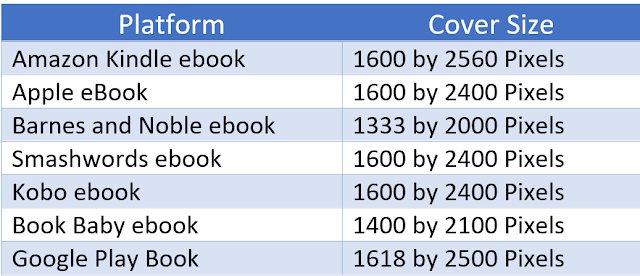
Publishing platforms recommended ebook cover dimensions

ebook-cover-dimensions-ebook-cover-size

eBook Publishing platforms cover size detentions video