Showing posts with label urdu islamic. Show all posts

Thursday, 4 May 2023

6 kalma With English Urdu Translation and Transliteration

6 kalma With English Urdu Translation and Transliteration. There are six kalams and numbers are assigned by the Ajam Muslim scholars due to the importance of this kalmas. It should be noted that out of the 6 kalmas, the words of the first 4 kalmas are definitely proven by the hadiths and the words of the fifth and sixth kalmas are given in different hadiths and are taken from the different supplications that are present in the hadiths.

In the subcontinent of Pakistan and India, some prayer words and glorification in the name of Shash Kalma (six kalmas) are very strictly memorized to children.


Refrences of 6 kalmas: The first kalma is in "Kanz al-Umal" and "Mustadrak Hakim", the second kalma  is in "Ibn Majah" and "Bukhari", the third kalma is in "Musnaf Ibn Abi Shaiba" and "Ibn Majah".the fourth kalma is found in "Musnaf Abd al-Razzaq al-Sanaani", "Musnaf Ibn Abi Shaiba" and "Sunan Tirmidhi" and the words of the remaining two kalmas are mentioned different hadiths. 


6 kalma with Urdu Translation
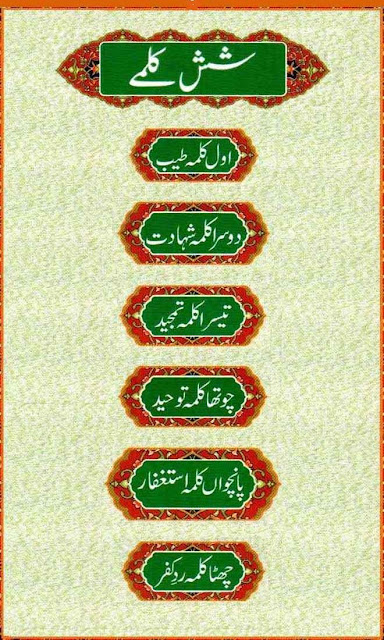
First Kalma tayyaba with Urdu Translation

Second Kalima Shahadat with Urdu Translation

Third Kalma tamjeed with Urdu Translation

Fourth Kalima tauheed with Urdu Translation

Fifth Kalma astaghfar  with Urdu Translation

Sixth Kalma Radde kufr with Urdu Translation


6 kalma Recitation


Reality and Importance of  6 kalmas

First Kalma: The first kalma is called is Tayyab. This kalma is proved by the hadiths. The transliteration words of this kalma is a ilaha illallah muhammadur rasulullah. The meaning of this kalma is There is none worthy of worship except Allah, Muhammad (PBUH) is the Messenger of Allah. The first kalma defines the fundamental faith compulsory to become a Muslim.
 
Kalima Tayyaba is one of the foundations of Islam. Rather, say that Kalima Tayyaba is the key of Islam. The first pillar of Islam is Kalima Tayyaba. There are countless virtues of this word, one of which is that the person who recite this words with a true heart will definitely go to heaven. It is important for the reciter of Kalima Tayyaba to know what the meaning of this Kalima. Secondly, for the reader of the this kalma should have perfect faith. Verily, Allah is the only God and the Holy Prophet (peace and blessings of Allah be upon him) is the Messenger of Allah. The main pillar of Islam is Kalima Tayyaba. Therefore, it is important to have sincerity in the heart while reciting these words. Muslims should not have any kind of doubt regarding monotheism and prophethood.

While reading these words, the focus of heart and mind should be on this word. Let it not happen that the word continues to be recited on the tongue while conspiracies against the humans of Allah are taking place in the mind. It is essential that the love of God and the love of the Messenger should be present in the heart while reciting these words. When You accepted Allah as the Lord and you accept the Prophet (peace and blessings of Allah be upon him) as Messenger, then you should get away from all kinds of pride and arrogance.
 
Everything in the universe was brought into existence for the belief of monotheism mentioned in the Kalima Tayyaba (first kalma), the testimony of this word was also given by the best creatures of Allah, this was also the preach of all the prophets, this is the secret of prosperity and success in this world and the hereafter. The words of first kalma is better than all the wealth of the world. Acknowledgment of the words of first kalma is the first duty for man. The remembrance of Allah in the heart is according to the faith of first kalma. The reward for the deeds that mentions first kalma (La ilaha ill Allah) is exaggerated. 

La ilaha illa Allah: The best charity, the source of salvation in the grave, the heaviest in weight, intercession and acceptance on the Day of Judgment and entry into Paradise.

La ilaha illa Allah: is the part of supplications recited for Ablution, adhan, after adhan, during and after prayer, Hajj and Umrah rituals, travel, night awakening and distress. Every dua that contains first kalma has greatest chance of acceptance. On the basis of the words or first kalma, the heavens and the earth are established, everything was created due to La ilaha illa Allah, and for this reason, Allah revealed books and sent messengers to spread or preach the message of first kalma among humans.
 
The saying of Mustafa (may God bless him and grant him peace) is: The best Zikr is La ilaha illa Allah and the best supplication is Alhamdulillah.” (Ibn Majah, Vol. 4, p. 247, Hadith: 3800)
 
All of us must have read a sentence in childhood and later taught it to children again and again. After the coming of Islam, the Arab warriors who used to commit robbery, kill each other, and shed the blood of many people for small things became Muslims after reading the kalma and left all bad habits and became brothers.
 
So, have you ever thought that those people who were experts in fighting, stealing and robbing, murdering for many years. They used to bury their girls alive. Many used to harbor enmity for many generations. After the introduction of Islam, what happened was that they immediately left all their bad habits and became noble and started living as brothers. Islam is still the same today. And why Muslims who believe in Islam generation after generation cannot get rid of their bad habits, why are they the most notorious in the world today. The easiest answer to this is that it is all a conspiracy of non-Muslims, they want to defame and humiliate Muslims. But if you are an honest Muslim, you will examine yourself. So you will know that the real reason for this is not the conspiracy of non-Muslims but our own imperfect faith.

We say kalma but we do not give its place to its meaning in our hearts and minds because we are born Muslims. After reading this word, we did not face the pains and difficulties that the companions of the Prophet (PBUH) and the Muslims of that time faced. They not only read the words of kalma but understood its meaning and also acted on it.

Let us take some time today to understand Kalma Tayyaba. We have sometimes considered what are the requirements of the Kalima Tayyaba, which all Muslims consider to be the strong foundation of their faith, and what this words demands from us.What does it mean when we say "Laala illa Allah"? Its literal meaning is known to almost all Muslims as "There is no god but Allah". So, have you ever considered why we do not consider anyone as a god except Allah and what are the qualities and attributes that no one else in this universe has. As we ponder, this fact becomes clear to us that God is real, that is, the numerous attributes of Allah are enough to make Allah the only God. If we accept a few of these qualities and attributes from the depths of our hearts, then we too will come to the path of guidance just with the blessing of this kalma, just like the warrior tribes of Arabia.

  1. The first quality without believing in which our faith cannot be complete is that Allah is present and watcher, that is, Allah is the only entity who is present everywhere in the entire universe, from the hearts of humans to the caves built in the mountains. Allah is the one who sees and hears everything even in the dark corners.
  2. The second quality is that he does not need anyone's help to run this universe, Allah alone is sufficient to run this entire universe. That is, Allah has no partner.
  3. The third quality is that Allah is the only one who provides sustenance to all living beings in this universe. No one can give sustenance to any inanimate and living beings except the one whom Allah himself makes a source of sustenance. Whether they are humans or jinns, birds or animals, beasts, living creatures living at the bottom of the sea or creatures living across the sky, it is Allah's responsibility to provide sustenance to all beings, and Allah fulfills this responsibility. It is maintained in a good way.
  4. Allah is the One who created all creatures. No matter how much science has progressed and all the scientists of the world can not create an organism equal to a small ant. The Most Merciful Allah created humans, jinns, animals, cattle, birds, beasts and innumerable living beings and placed in them various creative abilities, but living things can use these abilities with the order of Allah, Whose Power is in the Possession of Allah through the living things soul.
When we keep an eye on some of the above-mentioned qualities and attributes of Allah, then nothing can stop us from the path of guidance and nearness to Allah. That is, when we believe from our heart that Allah is present everywhere and is watching us, that Allah is the one who knows our every move and every small evil and good thing that comes in our heart, then it is not possible. That we should do or think anything that our true God has forbidden.
 
 
In this way, we will not mix the qualities and attributes of any worldly personality with the attributes of Allah, even the most respected person in the world, the Prophet ﷺ, because he is the beloved Prophet and Messenger of Allah.
 
 
Children are the greatest weakness of man. And this has been mentioned in the Qur'an by Allah Ta'ala Himself in a very clear way. When someone does not have children, the devil would lead them astray from the path of Allah and force to bow down to fake Gods through taweez or the practice of placing chadors on shrines or making vows. It is certain that a person will go astray if he/she does not have the belief in Allah as firm like as the sun rises every day. Allah has the power to give birth to someone. If this were not the case, in today's advanced era when medical science has made unlimited progress. Man has reached the moon and has invented many things, but the scientists of the whole world are not able to create a child, otherwise millions of people would not be childless today. It is only because of this perfect belief in Allah that a person can save your faith and belief in not having children that Allah alone has the power of creation.

 
If you want to ask for children, you should ask for it from a superior being. Although Allah is so glorious that Allah gives all the blessings of the world even to those who ask with stones. The only difference is that those people either do not believe in Allah from the beginning or they are wandering in error after believing, and Allah looses them in their error and leaves them to go astray and all their desires and wishes are fulfilled and they spend their whole lives in delusion, being intoxicated by their own intoxication.
 
 
On the contrary, a true believer who knows and understands the Word of Tawheed expresses all his desires and wishes to Allah and prays and hopes that they will be fulfilled, and thanks to Allah's mercy and grace for those prayers that are fulfilled. a true believer lives happily in the hope that Allah will reward him for deprivation of unfulfilled prayers in the Hereafter.
 
 
The second part of Kalima Tayyaba "Muhammad is the Messenger of Allah" which completes our faith, i.e. believing that Muhammad is the Messenger of Allah after the Oneness of Allah. Here, Allah has also defined the limits of our love for Muhammad ﷺ that we should believe that the Prophet ﷺ is the Prophet and Messenger of Allah. That is, the original faith is monotheism and you are the means of conveying the message sent by Allah to us, and the honorable person whom Allah chose to reveal the last book (Holy Qur'an). Therefore, it is our duty to respect the most honorable person who brought the Book of Allah and respect in such a way that he is dearer to us than everything and relationship in the world, but we recognize the status of Muhammad.
 
Here, I think it is important to explain another misunderstanding that people have automatically assumed that because we Muslims are from the ummah of Muhammad ﷺ, therefore due to the intercession of Muhammad, Jannah is destined for us. This is absolutely not the case, no one will be able to intercede in the Day of Judgment without the permission of Allah.
 
Have you ever met a person who brought you instructions from a great ruler and you did not obey any of his instructions, but you expected that the person who brings instruction will Recommend you to the ruler from whom those orders came. How will someone recommends you for the post of minister and advisor, if you did not obeyed the orders. So how can we think that we will openly disobey Allah and His Messenger.
 
If we all understood the importance and excellence of Kalima Tayyaba, then like the warrior tribes of Arabs, we would read the Kalima and leave all our bad habits and start living as brothers and sisters like true believers.
 
May Allah help us to understand the true spirit of Kalima Tayyaba. (Ameen)
 
Reciting La ilaha illallah 70000 times benefits: Hazrat Sayyiduna Sheikh Muhyiddin Ibn Arabi says: This hadith reached me: "Whoever recites La ilaha illa Allah seventy thousand times, will be forgiven, and the one for whom it is recited will also be forgiven.I had read Kalma Tayyaba 70000, but I did not intend it for anyone. Once I attended a feast with my friends. One of the participants in this feast was a young man with a great knowledge of Kashf. While eating, that young man started crying. I asked him the reason, he said: I see my mother suffering from punishment. I blessed the reward of 70000 times recitation of kalma to his mother in my heart. That young man immediately started smiling. And said: Now I see my mother in the best place.
 
Hazrat Sayyiduna Sheikh Muhyiddin Ibn Arabi, may God have mercy on him, used to say: "I recognized the authenticity of the hadith through the discovery of this young man, and the authenticity of the discovery of this young man through the hadith." (Marqat al-Mufatih, vol. 3, page. 222)
 
The reference of the 70000 times recitation hadith is weak.

 
Second Kalma:  The second kalma is called Shahadat, which is a literal confession of Muslim faith. 
The words of this kalma translitrated into english as "ashhadu alla ilaha illallah wahdahu la sharika lahu lahu wa-ash-hadu anna Muhammadan abduhoo wa rasooluhu" and the translation is "I bear witness that there is none worthy of worship except Allah, the One alone, without a partner, and I bear witness that Muhammad is His servant and Messenger". This is also more or less proven by the hadiths, and in the hadiths the virtue of reading it has been described.
 
The Messenger of Allah (peace and blessings of Allah be upon him) said, "Whoever recites this dua a hundred times a day, La ilaha illallah wahdahu la sharika lahu lahul mulku walahul hamdu wa owa ala kulli shayenqadir. So the recitor will get a reward equal to freeing ten slaves, a hundred good deeds will be written in book of deeds and a hundred bad deeds will be erased.This dua will protect him from Satan throughout the day. Until it is evening and no one will come with a better deed than the recitor, except the one who recites this words more than 100 times (Sahih Bukhari 3293).
 
Third Kalma: The third kalma is called Tamjeed. The transliteraiton of third kalma is "Subhaana-llaahi Walhamdu Lillaahi Walaaa Ilaaha Illa-llaahu Wallaahu Akbar. Walaa Hawla Walaa Quwwata Illaa Billaahi-l ‘Aliyyil ‘Azeem", and the translation is " Glory be to Allah and all praise be to Allah, there is none worthy of worship except Allah, and Allah is the Greatest. There is no might or power except from Allah, the Exalted, the Great One".

The words of this kalma are mentioned separately in two different hadiths. The first hadith is given in the Muslim and the second is given in bukhari sharif. 

Fourth Kalma: The fourth kalma is called Tawheed. The transliteraiton of fourth kalma is " Laaa Ilaaha Illa-llaahu Wahdahoo Laa Shareeka-lahoo Lahu-l Mulku Walahu-l Hamdu Yuhyee Wayumeetu Wahuwa Hayyu-l Laa Yamootu Abadan Abada. Dhu-l Jalaali Wal Ikraam. Biyadihil Khair. Wahuwa Alaa Kulli Shai-’in Qadeer.", and the translation is "There is none worthy of worship except Allah. He is alone and has no partner. To Him belongs the Kingdom and for Him is all praise. He gives life and causes death. In His hand is all good and He has power over everything".
 
Some of these words are definitely from the Holy Qur'an, but these words are not proven in this order.
 
Fifth Kalma: The fifth kalma is called astaghfar. The transliteration of fifth kalma is "Astaghfiru-llaaha Rabbi Min Kulli Dhambin Adhnabtuhoo ‘Amadan Aw Khata-an Sirran Aw ‘Alaaniyata-wn Wa-atoobu Ilaihi Min-adh Dhambi-l Ladhee A’lamu Wamina-dh Dhambi-l Ladhi Laaa A’lamu Innaka Anta ‘Allaamu-l Ghuyoobi Wasattaaru-l ‘Uyoobi Wa Ghaffaaru-dh Dhunubi Walaa Hawla Walaa Quwwata Illaa Billaahi-l ‘Aliyyil ‘Azeem.", and the translation is "I seek forgiveness from Allah, who is my Creator and Cheriser, from every sin I committed knowingly or unknowingly, secretly or openly. I also seek His forgiveness for all sins which I am aware of or am not aware of. Certainly, You (O Allah!), are the Knower of the hidden and the Concealer of mistakes and the Forgiver of sins. And there is no power and no strength except  Allah, the Highest, the Greatest".
 
These words are not mentioned anywhere in the Qur'an and Hadith in this order.
 
Sixth Kalma: The sixth kalma is called Radde kufr. The transliteration of sixth kalma is "Allaa-humma Inneee A’udhu-bika Min An Ushrika Bika Shay-awn Wa-ana A’lamu Bihee Wa- astaghfiruka Limaa Laaa A’lamu Bihee Tubtu ‘Anhu Wata-barraatu Mina-l Kufri Wash-shirki Wal-kidhbi Wal-gheebati Wal-bid’ati Wan-nameemati Wal-fawahishi Wal-buhtaani Wal-m’aasi Kulli-haa Wa-Aslamtu Wa-aqoolu Laaa Ilaaha Illa-llaahu Muhammadu-r Rasoolu-llah", and the translation is " O, Allah! I seek refuge in You from that I should ascribe any partner with You knowingly. I seek Your forgiveness for the sin of which I have no knowledge. I repent from it. And becoming disgusted by disbelief and idolatry, lying and backbiting, innovation and slander, lewdness and abomination, and all other acts of disobedience, I submit to Your will. I believe and declare that there is none worthy of worship except Allah and Muhammad is the Messenger of Allah".
 
These are also prayer words whose origin is unknown.
 

Summary

The 6 kalma were made famous by scholars in the sub-continent because the people were unfamiliar with Arabic, so they taught them prayers in short words, but there was a disadvantage of following them consistently and strictly, just like Surah Yaseen. Exaggerations were used in virtue, innovations were invented. As a result, people ignored the best surahs like Surah Al-Baqarah and Surah Al-Kahf. And also deprived of proven virtues.
 
In exactly the same way, these 6 kalma were exaggerated in intensity and virtue, so that the majority of our children were deprived of Sayyid al-Istighfar and Masnoon Azkar in the morning and evening. Most of them only contain some Quranic words in Arabic. There are words contains the praise of Allah - no Shariah evidence is found with the above order and the above names. There is no compulsion to memorize them all and memorizing the duas of the Prophet (may God bless him and grant him peace) mentioned in the hadith if better. It is even better to remember the words and prayers that are present in the hadith that are confirmed by the Prophet.
 
People are being made to believe that whoever does not remember or memorize these 6 kalma has a weak faith. Not remembering words is not a measure of faith, nor is it an extra virtue. There can be two opinions on making a collection by collecting the words of Masnoon, but imposing it on the public is nothing but pure ignorance.
 
Misconception about 6 kama: There is a misconception about these six kalmas that every Muslim must memorize it. Which is a wrong concept about these kalmas. Memorizing the 6 kalmas is not a measure of faith, nor is it an extra virtue. Imposing it on the public is nothing but pure ignorance.
 
Note: It should be clear that this sequence and number is not proven by hadith.

Wednesday, 29 March 2023

Dua e Qunoot For Witr Namaz English Urdu Translation

Qunoot means humility, obedience and devotion. In Islam dua e qunoot is type of supplication that is recited after Surah Al-Fatiha and any other Surah during Qiyam in the last rakat of the three Witr of the Isha prayer.


What is Witr Prayer (Namaz) and how to Perform it?

Witr means odd number. Witr consists of three rakahs. The meaning of Witr is odd number and three rak'ahs represent an odd number due to which the Witr prayer is called Witr. In Islamic terminology, the Witr prayer is performed after the Farz (first 4 obligatory rakat) and sunnahs in the Isha prayer. Witr prayer consists of three rak'ahs. In witr it is wajib to add Surah after reciting Fatiha in every rakah. The method of performing the 3 witr rakahs is similar to other prayer. First perform 2 rakahs and in the third rakah after reciting surah in Qiyam, raise your hands to your ears before bowing(rukuh) and say Allahu Akbar as you do in Takbeer Tahirima, then bring your hands to its position as we do in Qiyam and read the Dua Qunut. it is obligatory to recite the Dua e Qunoot in witr.


In the light of the hadith, the Muslim Ummah agrees that we must perform Witr prayer; Because the Holy Prophet (peace and blessings of Allah be upon him) always used to perform the Witr prayer during his travels, and the Holy Prophet (peace and blessings of Allah be upon him) emphasized on praying the Witr prayer, even if a person could not pray the Witr prayer on time, should do it later. 


Hazrat Abu Saeed Khudri says that the Messenger of Allah (may God bless him and grant him peace) said: Pray the Witr prayer before dawn.


The Prophet (peace and blessings of Allah be upon him) has ordered Muslims to perform Witr mention in several hadith. Missing the Witr prayer from the Prophet (peace and blessings of Allah be upon him) even once in his life is not proven even on the occasion of Hajj.


When to read dua e qunoot in witr

It is recited in the last rakah of the three witr of Isha prayer after reciting surah fatiha + surah.

Can we recite surah ikhlas instead of dua e qunoot?


No, You cannot recite surah ikhlas because reciting dua in witr is wajib(obligatory act) and reciting Dua Qunut is Sunnah mu'akkadah (confirmed sunna) . You can recite any alternative for dua e qunot provided below.


What to do, if Dua e Qunot is not memorized?

Many muslims asked the questions like what to read in witr namaz instead of dua-e-qunoot, is dua qunoot compulsory for witr, is dua e qunoot compulsory in witr hanafi or What can I say instead of dua e qunot?
 
If a person does not remember Dua Qunut, what can he/she recite instead and is it acceptable? Reciting dua is wajib (obligatory act) in witr but dua-e-Qunoot is not wajid, it is Sunnah mu'akkadah (confirmed sunna). So every Muslim should memorize this dua e qunut.If it is difficult for someone to recite or memorize Dua e Qunut then you should recite one of the following (alternative for dua e qunoot), so that the wajib is fulfilled.

Rabbana atina fid dunya hasanatan wa fil Aakhirati hasanatan waqina ‘adhaban-nar (Surah Baqarah ayah 201)

رَبَّنَآ ءَاتِنَا فِى ٱلدُّنْيَا حَسَنَةً وَفِى ٱلْـَٔاخِرَةِ حَسَنَةً وَقِنَا عَذَابَ ٱلنَّارِ

 or Recite

 Rabbighfir warham wa anta khairur rahimeen |  رَبِّ اغْفِرْ وَارْحَمْ وَأَنْتَ خَيْرُ الرَّاحِمِينَ

  or simple Recite 

Allahummaghfirli   |   اَللَّهُمَّ اِغْفِرْ لِي


What to do if dua Qunut is forgotten?

If a person forgets to recite Dua Qunot in the third rakat of Witr prayer and goes into Ruku, and then remembers during Ruku, returns to Qiyam and recites Qunoot again, will this method be accepted? If a person forgets to recite the dua e Qunut in the third rakat of Witr prayer and goes into Ruku, then it is ordered, not to return to Qiyam to recite dua e Qunut, but to complete the prayer without reciting dua-e-qunoot and at the end do Sajdah Sahw.


Proof of Reciting Dua e Qunoot in Witr Prayer?

The Prophet (peace and blessings of Allah be upon him) used to recite various dua-e-Qunoot in the Witr prayer, and the due-Qunoot is generally recited in witr by Hanafis. It is proved by the Holy Prophet (peace and blessings of Allah be upon him). And the proofs are in the following books. These references are given short, so for full reference visit this page.

  1. The author Ibn Abi Shaiba (Vol: 2, page: 106) 
  2. Author Abdul Razzaq (Vol: 3 page. 114)
  3. Al-Marasil Labi Dawood Sajistani (page: 118)
  4. Mukhtasar Qiyam al-Lail by Muhammad bin Nasr al-Maruzi (Vol: 1, page. 321)
  5. Sharah Maani ul-Asaar by Imam al-Tahawi (vol: 1, page. 249)
  6. Al-Dua Al-Tabarani (page. 238)
  7. Al-Sunan al-Kubra al-Bayhaqi (page. 299)
  8. Kanzu'l-Ummal Ali al-Muttaqi al-Hindi (Vol.: 8, page.75)
  9. AlDawatul Kabeer Baihaqi (Vol: 1, page: 559)


The reason for preferring Dua e Qunot?

The Hanaf (Islamic Scholars follow Imam Hanifa) have given priority to the above-mentioned Dua-e-Qunoot because:

First reason for preference: It is narrated from Khalid bin Imran that this Dua e Qunoot was taught to Hazrat Muhammad (PBUH) by Hazrat Gabriel. (Al-Marasil Abu Dawud, page 118)

Second reason for preference: Dua e Qunot is narrated by the following Companions (may Allah be pleased with them):

  • Hazrat Umar bin Al-Khattab (RA).
  • Abdullah Bin Masood (Radiyallahu Anhu)
  • Ubi bin Ka'b (may Allah be pleased with him)
  • Ali Ibn Abi Talib (Radiyallahu Anhu)
  • Hazrat Usman bin Affan (RA).
  • Khalid bin Abi Imran (RA).
  • Anas bin Malik (RA).

 Dua e Qunoot in Arabic 

This is the Arabic version that you have to recite in the Witr prayer (in last rakat of Isha prayer). 
 اَللَّهُمَّ إنا نَسْتَعِينُكَ وَنَسْتَغْفِرُكَ وَنُؤْمِنُ بِكَ وَنَتَوَكَّلُ عَلَيْكَ وَنُثْنِئْ عَلَيْكَ الخَيْرَ وَنَشْكُرُكَ وَلَا نَكْفُرُكَ وَنَخْلَعُ وَنَتْرُكُ مَنْ ئَّفْجُرُكَ اَللَّهُمَّ إِيَّاكَ نَعْبُدُ وَلَكَ نُصَلِّئ وَنَسْجُدُ وَإِلَيْكَ نَسْعأئ وَنَحْفِدُ وَنَرْجُو رَحْمَتَكَ وَنَخْشآئ عَذَابَكَ إِنَّ عَذَابَكَ بِالكُفَّارِ مُلْحَقٌ

Image of Dua e qunoot witr


Dua e Qunoot transliteration English

Image of Dua e Qunoot transliteration

Dua e Qunoot in English Translation

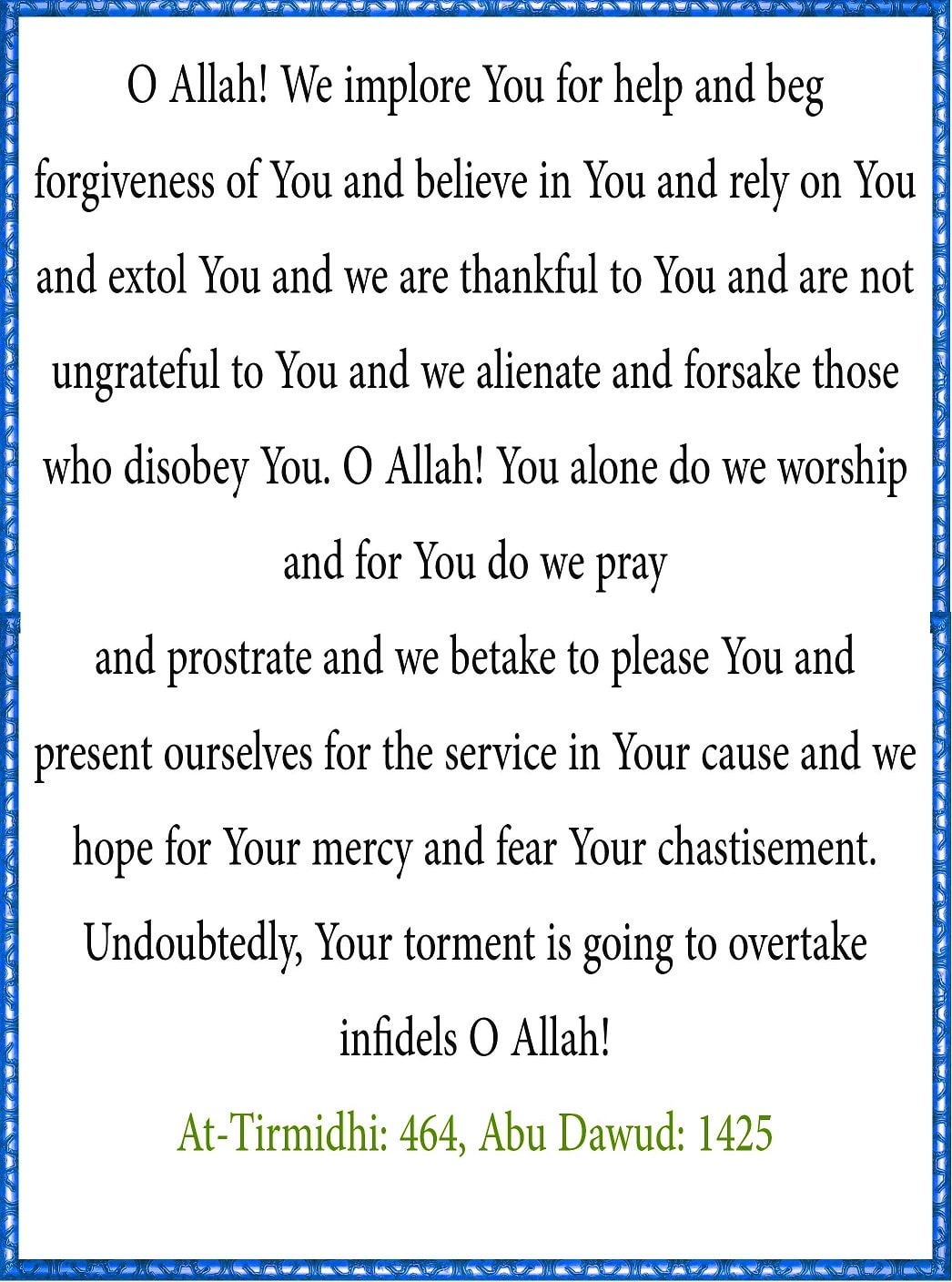
O Allah! We implore You for help and beg forgiveness of You and believe in You and rely on You and extol You and we are thankful to You and are not ungrateful to You and we alienate and forsake those who disobey You. O Allah! You alone do we worship and for You do we pray and prostrate and we betake to please You and present ourselves for the service in Your cause and we hope for Your mercy and fear Your chastisement. Undoubtedly, Your torment is going to overtake infidels O Allah!
At-Tirmidhi: 464, Abu Dawud: 1425

Image of Dua e Qunoot in English Translation


دعائے قنوت

قنوت کے معنی ہیں عاجزی، اطاعت اور عقیدت۔ اسلام میں دعائے قنوت ایک قسم کی دعا ہے جو نماز عشاء کے تین وتر کی آخری رکعت میں سورہ فاتحہ اور قیام کے دوران کسی دوسری سورت کے بعد پڑھی جاتی ہے۔


کیا دعائے قنوت کے بجائے سورہ اخلاص پڑھ سکتے ہیں؟
 
نہیں، آپ سورہ اخلاص نہیں پڑھ سکتے کیونکہ وتر میں دعا پڑھنا واجب  ہے اور دعا قنوت پڑھنا سنت مؤکدہ ہے۔ آپ دعائے قنوت کے بجائے کوئی بھی متبادل دعا پڑھ سکتے ہیں۔ لہٰذا ہر مسلمان کو یہ دعاءِ قنوت حفظ کرنی چاہیے، اگر کسی کے لیے دعاءِ قنوت پڑھنا یا حفظ کرنا مشکل ہو تو آپ درج ذیل میں سے کوئی ایک پڑھے، تاکہ واجب پورا ہو جائے۔ 
 

رَبَّنَآ ءَاتِنَا فِى ٱلدُّنْيَا حَسَنَةً وَفِى ٱلْـَٔاخِرَةِ حَسَنَةً وَقِنَا عَذَابَ ٱلنَّارِ

 یا

 رَبِّ اغْفِرْ وَارْحَمْ وَأَنْتَ خَيْرُ الرَّاحِمِينَ

یا

 اَللَّهُمَّ اِغْفِرْ لِي


وتر میں رکوع سے قیام کی طرف لوٹنا
 
اگر کوئی شخص نماز وتر کی تیسری رکعت میں دعاء قنوت پڑھنا بھول جائے اور رکوع میں چلا جائے اور پھر رکوع میں یاد آئے، قیام میں آکر دوبارہ قنوت پڑھے تو کیا یہ طریقہ قبول ہوگا؟ اگر کوئی شخص نماز وتر کی تیسری رکعت میں دعاء قنوت پڑھنا بھول جائے اور رکوع میں چلا جائے تو حکم ہے کہ قیام کی طرف واپس نہ ائے بلکہ نماز مکمل کرے اور آخر میں سجدہ سہو ادا کریں۔
 

Dua e Qunoot in Arabic with Urdu Translation

Image of Dua e Qunoot with Urdu

Image of Dua e Qunoot with Urdu

Dua e Qunoot in Urdu Translation

Dua e Qunoot in Urdu Translation


Dua Qunoot in Arabic Audio Video ( word to word recitation)


Dua Qunoot with urdu translation word by word video


Dua e qunoot translation in English Video

Sunday, 19 March 2023

Why don't sunnis mourn in muharram

Why don't sunnis mourn in muharram complete detail based on islamic teaching Quran and Hadiths.


Why don't sunnis mourn in muharram

Is the virtue of Muharram due to the martyrdom of Hussain (RA)?

Many people believe that the month of muharram ul haram or the 10th of Muharram has been blessed because of Hazrat Hussain and the martyrs of Karbala. This is completely false and wrong for many reasons.

  1.  The main reason for the greatness and grace of a certain time, day or month is the attraction and manifestation of the special blessings and mercies of Allah, and the occurrence of some important events during this time is also a cause of grace in the second degree. It happens, like the revelation of the Holy Qur'an in Ramadan and the occurrence of Shab Qadr, etc. And the proof of excellence in any day can only be known from the Qur'an and Sunnah, it cannot be explained by oneself. While it is not proven from the Qur'an and Hadith that Muharram and Ashura got excellence due to the martyrdom of Hazrat Hussain.
  2. The month of muharram ul haram is one of the four holy months, which Allah Ta'ala has favored since the birth of the heavens and the earth, as mentioned in the verse of Surah At-Tawbah, and in the same way, it has been mentioned in detail in the blessed hadiths that the Jews and Quraish of Makkah also considered this day as great and respectable. , and the Messenger of Allah (peace and blessings of Allah be upon him) himself also described the excellence of this day, and called fasting on this day a reward. While the tragedy of Hazrat Hussain's martyrdom happened much later in the year 61 Hijri, how is it possible that Muharram and Ashura are blessed because of Hussain's martyrdom? That Allah Ta'ala chose this respectable and auspicious day for the martyrdom of his popular servant Hazrat Hussain (RA), therefore the month of Muharram or Ashura did not gain excellence because of the martyrdom of Hazrat Hussain (RA), but Hazrat Hussain (Radiyallahu Anhu) himself gained even more merit for being martyred on that day.


 Why don't sunnis mourn in muharram

Is muharram ul haram a month of grief and mourning? Some people believe that Hazrat Hussain, his family and his companions were brutally martyred in this month, so this month is a month of grief and those people mourn it. Declaring it a month of mourning, they avoid doing happy things , don't even get married, don't build a house, don't do any happy ceremony, don't adorn yourself, don't wear new clothes and wear black clothes in this month to express grief, mourn. All these things have no origin in the Islamic Shari'ah, and declaring this month as the month of grief is invalid for the following reasons.

  1. The act of mourning in memory of a martyr on the basis of martyrdom is not proven by the Messenger of Allah, may God bless him and grant him peace. Indeed, the martyrdom of Hazrat Hussain, the great-grandson of the Messenger, is a painful and soul-shattering event, but in the memory of Hazrat Hussain and any deceased and martyred believer, on any day or month, Declaring a day or a month of grief is baseless, declaring any month as a month of grief is not proven by the Qur'an, Sunnah and Shariah arguments.
  2. The occurrence of a sad event in a month or day does not make it special for s ad that day should always be celebrated as sadness, and despite the passage of centuries it is called the month of sadness, if so, then Islamic history is filled with many such sad tragedies and incidents that occurred in twelve months of the year, there have been tragic martyrdoms of great Companions of Prophet Muhammad.  As the painful martyrdoms of Hazrat Hamza, Hazrat Sohaib, Hazrat Umar, Hazrat usman, Hazrat Ali and many other companions of the Prophet (may Allah be pleased with them) are part of the history. Because of their martyrdoms , the whole year should be declared sad, obviously, no one can admit it, Then which can be greatest tragedy than the death of the Holy Prophet (PBUH) for the ummah? Hazrat Syed Sheikh Abdul Qadir Jilani (may God bless him and grant him peace) says that if this day is considered a day of grief because of the martyrdom of Imam Hussain (RA), then Monday is a day to grieve even more, because The Messenger of God, may God bless him and grant him peace, died on the same day and the first Caliph Hazrat Abu Bakr died on the same day.
  3. It is not permissible to mourn someone's death for more than three days: It should be noted that on the death of a person, it is permissible for the family to mourn for three days and it is not permissible to mourn for more than three days, however, if a woman's husband dies, she will mourn for four months and ten days. .

Is Muharram a month of curse?

In Islam, there is no concept of badness of any day, month, year or anything. In the religion of Islam, the virtues and blessings of certain times have been described on the basis of certain characteristics, but there is no concept in Islam about badness of a time.It comes in the hadith Sharif: It was narrated from Hazrat Abu Huraira (RA) that the Prophet (PBUH) said: “Allah Almighty says that the ibn-e-aadam hurts me and curses the age, even though I am the creator of the time. I'm doing all things. I have all the things in my hand, I turn the night and the day as I will".

Therefore, it was found that the cause of unhappiness and happiness is not time etc., neither any day is unlucky, nor any month, nor is it unlucky in any house, nor in any person, but the real unhappiness is in sin and sinful actions. Therefore, considering the month of Muharram as inauspicious, as people think it is a false and baseless belief, it has no origin in Islam.


Order to marry in Muharram

Due to the tragedy of the martyrdom of Hazrat Hussain (RA) in the month of Muharram, it has settled in the minds of some people that it is a month of grief and mourning, so it is not permissible to hold weddings and celebrations in it. People think that Celebrating joyous events in the this month will result bad. There is no good and blessing in it and the marriage fails, although this thought is not completely correct, as it is known from the previous description that the month of Muharram is a blessed month with greatness and sanctity.
 
In Fatawi Haqqaniyyah, it is written that: Muharram is a month like other months of the year, just as it is permissible to marry in other months of the year, it is also permissible in Muharram. Shias have spread this ugly and baseless thing among the people, it is necessary for Muslims to abandon this innovation.
 
Maulana Saifullah Khalid Rahmani Sahib writes: In Islam, no month, no day or any time is inauspicious and inauspicious, and the month of Muharram has many virtues, the day of Ashura itself also has great virtues. The heartbreaking incident of the martyrdom of Hazrat Hussain (R.A), the beloved grandson of the Messenger of Allah (may God bless him and grant him peace) happened in this month, but because of this incident, it is very wrong to understand that one should not get married on this day or in this month, because Islam is the religion of the braves, there is no month and no date in which the martyrdom of a companion, or a great mujahid and martyr of Islam did not occur. Should muslim Avoid Marriages in those months and days? Before Islam, Arabs did not marry in the month of Shawwal. So, the Messenger of Allah (may God bless him and grant him peace) married Hazrat Aisha in month Shawwal, and departed in Shawwal. That is why Hazrat Aisha (R.A.) liked that the women of her family should get married in Shawwal. By this action, the intention of the Aisha (R.A) must have been that the matter of not marrying in such and such a particular month should be removed from people's minds, so there is no wrongdoing in marrying in the month of Muharram.
 

Why don't sunnis mourn in muharram: Muharram celebration as mourning and lamentation

The Messenger of Allah (peace and blessings of Allah be upon him) described beating the chest, beating the face, cutting the neck, wailing and mourning as the customs and practices of the Jahiliyyah era, and said that this action is a cause of curse, rather it leads to disbelief. .
 
It is narrated in Sahih Muslim: On the authority of Hazrat Abu Huraira (R.A) that the Messenger of Allah, may God bless him and grant him peace, said: There are two things which are disbelief: one is taunting one's family, and the other is lamenting over the dead.
 
It is in Al-Bukhari Sharif: It was narrated on the authority of Hazrat Abdullah bin Masoud (RA) that the Messenger of Allah (PBUH) said: The Person is not one of us who beats his face (in times of trouble) and tear up neck and wail like ignorance.
 
In addition to this, many blessed hadiths clearly condemn all non-Sharia acts such as wailing, shouting, wailing, talking like ignorance, necks and clothes tearing, beating the face, scratching the face, and mourning during times of trouble. Strict covenants have been made regarding them, so a Muslim should avoid these non Islamic acts.
 

Wear black cloths

There is nothing wrong with wearing black clothes, the Prophet himself (peace and blessings of Allah be upon him) wore a black turban, a black cloak, and a black robe. But wearing black as a sign of sadness is not permissible.

This was some short note on Why don't sunnis mourn in muharram with justification and proofs.

Thursday, 16 March 2023

Muharram Ul Haram Month Guide And Information

muharram-ul-haram


The month of Muharram Ul Haram is the first lunar month of the Islamic year.


 Muharram ul haram meaning

Literary research of the name Muharram Ul Haram: This month is called "Al-Muharram" in Arabic, the word "Muharram" is derived from Hurmat, the literal meaning of Hurmat is "majesty and respect".


Why "Muharram Ul Haram" is called Muharram?

 The first reason: The Arabs considered fighting in this month as forbidden, so this month is named "Muharram".

Second Reason: Muharram is called Muharram because of its majesty and sanctity, because it is one of the "Ashar Harams", but according to Allama Sakhawi (may God have mercy on him) the Arabs used to play with this month during the Jahiliyyah, sometimes making it haram for fighting. and sometimes would have been made halal, so it is called "Muharram" to emphasize the prohibition of fighting in this month.


Virtues of Muharram

1. Islamic calendar starts from month of Muharram Ul Haram

Before Islam, this month was considered highly respected even in the era of Jahiliyyah and the people of Makkah used to start the new year from this month. During the caliphate of Hazrat Umar Farooq, when the issue of Islamic history was discussed, with the consensus of the Companions, "Muharram" was declared as the first month of the Islamic year. 


Allama Ibn Sirin says: A person came from Yemen and said: I have seen something in Yemen. What is called history, and is written from a specific year and month. Then Hazrat Umar (RA) said: This is a very good thing. Therefore, you also set a date. So, the companions of the Prophet were gathered for consultation, some said: It should begin with the birth of the Prophet (peace and blessings be upon him). Some said: It should begin with the revelation of first verse of Quran. Someone said: From migration and someone said: History should begin from death of Hazrat Muhammad. So Hazrat Umar (RA) said: Start it with Hijra itself, then the question arose that which month should be declared as the first month of the Islamic year?


Someone said: Rajab, because even the people of Jahiliyyah used to respect it. Someone said: The month of Ramadan. Someone said: Dhul-Hijjah because Hajj is performed in it. Someone said the month of Migration from Makkah to Madinah, Someone said: The month in which the Prophet (peace and blessings of Allah be upon him) reached Madinah should be considered the first month of the Islamic year. So Hazrat Uthman Ghani (RA) said, "Start with Muharram Ul Haram," because it is a holy month, and secondly, it was also considered the first month among the Arabs, and then it is also the month of returning from Hajj, So by consensus Muharram was declared as the first month.


Allama Ibn Hajar Asqalani (may Allah have mercy on him) says: One of the reasons for setting the date is that Hazrat Abu Musa (RA) wrote a letter to Hazrat Umar (RA) saying that letters are coming to us from you and dates are not mentioned on it. So Hazrat Umar (RA) gathered the people and asked them for their advice. Some said: Count from first revelation and some said: Count from migration. Hazrat Umar Radiyallahu Anhu said: Hijra made the difference between right and wrong, so calculate history from Hijra itself.


Some traditions also prove that the Islamic year of Hijri was started by the order of the Messenger of Allah (peace and blessings of Allah be upon him) during his lifetime, but it was regularly recorded in official messages during the caliphate of Hazrat Umar Farooq (RA). In fact, Allama Suyuti (may Allah have mercy on him) has declared this to be right.


Why was the Islamic year determined by the Prophet's migration?

Allama Ibn Hajar Asqalani (may Allah have mercy on him) wrote that in the fourth or fifth year of the caliphate of Hazrat Umar Farooq, when the issue of history was discussed, there were four such incidents in front of the Companions that could be used to start Islamic year.
  1. Birth of the Holy Prophet
  2. The day when first revelation was send to Holy Prophet (peace be upon him).
  3. Migration of the Holy Prophet (peace be upon him).
  4. Death of the Holy Prophet (PBUH).
But the great Companions (Hazrat Umar, Hazrat Uthman Ghani and Hazrat Ali) preferred migration, because there was a difference in the determination of birth and first revelation, while death was deliberately avoided, because it always causes sadness. And grief would have been expressed, so the date was determined by the event of migration.
 
The first month of every new Islamic year reminds us of the great event of the Prophet's migration, and renews the pledge that if Muslims face hardships and sufferings for the sake of exalting the religion, If the mountains of oppression are broken, if you have to sacrifice your family and everything for the protection of your religion and faith, then sacrifice it, but do not allow your steadfastness to slip, and do not let your religion and faith be affected.]


2. Muharram Ul Haram is one of the four glorious months


The month of Muharram Ul Haramis one of the four months, which Allah Almighty has declared as "Ashhur Huram (اشہُر حُرُم)" meaning sacred months.

Allah Almighty says in Surah At-Tawbah: The fact is that according to Allah, the number of months is twelve months. Which, according to the Book of Allah, comes into effect from the day Allah created the heavens and the earth. Four of these twelve months are sacred months.
 
These months were called sacred months ( اشہُر حُرُم ) with two meanings: One is because fighting / killing is prohibited for a long time in it, the other is because these months are blessed and obligatory to respect, in them the reward of worship is more, however, the first of them has been abrogated in the Sharia of Islam, while the second command is respect and respect. And the order of worship is still in Shariat.

Virtue of worship in the month of Muharram and severity of bad deeds and sins: Doing good deeds during Muharram and the rest of the sacred months is more preferable than other months, and doing sins in these months is a more severe than other months.
 
 
Imam Abu Bakr Jisas has written: "Whoever worships in these blessed months, will be blessed from Allah to worship in other months as well, and whoever tries to avoid sins in these months, It becomes easier to avoid sins during the rest of the months. Therefore, efforts should be made to worship and avoid sins during these months.


3. Virtues of fasting in the month of Muharram

The Messenger of Allah (peace and blessings of Allah be upon him) said that the best fasts after the month of Ramadan are the fasts of Muharram .
 
Mulla Ali Qari says that in this hadith Sharif, the fasting of the entire month of Muharram Ul Haram is meant, so this virtue of fasting is not only special for the 10th day of Muharram, but it is a virtue to fast on any day of the entire month.


4. Muharram is the honorable month of Allah

All the months belong to Allah, but to clarify the excellence and greatness of this month, the Messenger of Allah (PBUH) called it the month of Allah, because it is the month of Allah's special blessings.


Allama Ibn Rajab Hanbali writes that the name of Muharram was named "Shahrullah:شھر اللہ" by the Messenger of Allah (peace and blessings be upon him). This addition and relation to Allah Almighty indicates the honor and excellence of this month. Because among the creatures there can only be a special relationship with Allah, such as Muhammad, Ibrahim, Ishaq, Ya'qub and other prophets (peace be upon them) with being a servant of Allah. In the same way, the Kaaba of Allah and the camel of Salih (peace be upon him) turned towards Allah, And this month was also made special by referring to Allah Ta'ala. In the same way, if fasting is attributed to Allah Almighty, then it is possible that it has been attributed to Allah Almighty because of this particular action, i.e. fasting.
 
 
One of the reasons is that in referring this month to Allah Ta'ala, there is an indication that its sanctity is from Allah. No one else has the authority to change its sanctity, as in the age of ignorance people used to make it halal for fighting. And in its place, Safar used to be forbidden, so it was pointed out that it is the month of Allah Almighty, Allah has made it respectable, so it is not permissible for any of the creatures to change it.


5. This is the best month in Ashar Haram

According to Hasan Basri and later scholars, the month of Muharram is the best month among the sacred months (Dhu Qa'dah, Dhu al-Hijjah, Muharram and Rajab).


6. Allah has sworn on the dawn of 1st of Muharram Ul Haram

Allah has sworn by the dawn of the 1st of Muharram Ul Haram to explain the importance of the month of Muharram in the Holy Quran. Allah says: I Swear by the time of dawn, and ten nights, and even and odd. (Al-Fajr, verse number: 1, 2, 3)

Hazrat Ibn Abbas says that Fajr in this verse refers to the Fajr of the 1st of Muharram, because it is the first Fajr of the year.
 
Mmuharram ul haram 2023 will start on 19th of July, 2023.


Other Questions asked about Muharram

The anserser to all the Quesiotns can be found in the above two guides, if you did not get it on this page.
  1. why is muharram celebrated
  2. what is muharram in islam
  3. what happened in muharram
  4. who celebrate muharram, shia or sunni
  5. Do Sunnis believe Muharram?
  6. Do Shia believe in Muharram?
  7. Why do Shias observe Muharram?
  8. Is Karbala Sunni or Shia?
  9. What is Muharram for Sunnis?
  10. How do Sunnis mourn in Muharram?
  11. Is Karbala Sunni or Shia?
  12. Why is Muharram important in Islam?
  13. What does Quran say about Muharram?
  14. Why was Muharram celebrated?
  15. What does Quran say about Muharram?
  16. Why is it called Muharram?

Friday, 3 March 2023

Zakat books in Urdu pdf download Hafiz Salahuddin Yousaf

Zakat books in Urdu pdf download. The book name is Zakat Ushr Aur Sadaqat Ul Fitr By Hafiz Salahuddin Yousaf.

 Zakat, which is also one of the five pillars of Islam, is a duty that has two aspects. Since it is a form of worship, it is related to the rights of Allah and because it benefits the humans, the economic support of millions of poor and needy, orphans and widows and disabled people are related to Zakat. In this sense, it is also related to the human rights. This shows the importance and usefulness of Zakat. It is a worship, means that by paying it, a person gets a special closeness to Allah and His pleasure, and the other side of it is that it is also a great source of financial support for the disabled and poor people of the society. It awakens in a person's heart the desire to know about the needy and wish them well.

 Due to its dual status, it has a prominent position in other acts of worship. Due to its importance and usefulness, this book has been compiled. In it, on the one hand, an attempt has been made to explain all the essential issues of Zakat in the light of the Qur'an and Hadith, because its religious status requires that the commands and instructions of Allah and the Messenger has been discussed. On the other hand, its aspects have been highlighted through which the economic and social benefits of Zakat can be brought out and maximum work can be done from it for the welfare of the needy people of the society.

Zakat Ushr Aur Sadaqat Ul Fitr By Hafiz Salahuddin Yousaf Contents

  1. Ruling on Zakat in previous shariats
  2. Importance and usefulness of Zakat in Islam
  3. Meaning of Zakat
  4. Words of wisdom on the Holy Quran
  5.  Strict prohibition for asking without need
  6. It is permissible to only three types of people
  7.  Responsibilities of givers of of zakat
  8. A strange example of worldly blessing of zakat
  9. Benefits of Distributing Zakat Collectively
  10. Virtues and blessings and its need and importance
  11.  A strict punishment not to pay Zakat on wealth
  12. A strict punishment for those who do not pay Zakat on animals
  13. punishment not to pay Zakat on gold and silver
  14. Worldly Punishment of not giving Zakat
  15. Zakat and other sadqat
  16. The Prophet's instructions to those who receive Zakat
  17. Government officials are not allowed to accept Zakat
  18. Relatives are the first deserving of charity
  19. It is permissible to pay Zakat before the due date
  20. Justification for delay in spending the accumulated Zakat
  21.  To end poverty and corruption
  22. Zakat is worship, not a tax
  23. A better plan is to withdraw zakat from haram earnings and give charity
  24. Two conditions are necessary for the collection of Zakat and taxing
  25. Give charity secretly and don't show favors
  26. And many More topics are discussed regarding Zakat
Zakat books in Urdu pdf download Hafiz Salahuddin Yousaf

Zakat books in Urdu pdf download

Friday, 11 November 2022

True Islamic story | Backbiting Real Islamic Story

This True Islamic story in Urdu | اسلامی قصہ | اسلامی دلچسپ واقعات | نصیحت آموز اردو واقعات

ایک تابعی جس کا نام ربعی ؒ ہے وہ اپنا واقعہ بیان کرتے ہیں کہ ایک مرتبہ میں ایک مجلس میں پہنچا، میں نے دیکھا کے لوگ بیٹھے ہوئے باتیں کر رہے ہیں، میں بھی ان کے ساتھ مجلس میں بیٹھ گیا۔ اب باتیں کرنے کے درمیان کسی کی غیبت شروع ہوگئی۔ مجھے یہ بات بہت بری لگی کہ ہم یہاں مجلس میں بیٹھ کر کسی کی غیبت کر رہے ہیں۔ چنانچہ میں اس مجلس سے اٹھ کر چلاگیا۔ اس لیے کہ اگر کسی مجلس میں غیبت ہو رہی ہے۔ تو اپ کو چاہیے کہ اس غیبت کو روکے اور اگر روکنے کی طاقت نہ ہو تو کم از کم اس مجلس کو چھوڑ کراس گفتگو میں شریک نہ ہو، بلکہ اٹھ کر چلے جائے۔  ربعیؒ نے کہا کہ میں اس مجلس سے اٹھ کر چلاگیا۔  تھوڑی دیر بعد خیال آیا کہ اب مجلس میں غیبت کا موضوع ختم ہوگیا ہوگا، اس لیے میں دوبارہ اس مجلس میں جاکر بیٹھ گیا۔  اب تھوڑی دیر ادھر اُدھر کی باتیں ہوئیں لیکن تھوڑی دیر کے بعد پھر غیبت شروع ہوگئی۔ لیکن اس بار مجبوری کے وجہ سے میں مجلس سے اٹھ نہ سکا اور جو غیبت وہ لوگ کر تے رہے میں اسے سنتارہا، میں نے بھی غیبت میں حصہ لے کر ایک دو جملے کہہ دیئے۔

جب میں اس مجلس سے گھر آیا اور رات کو سویا تو خواب میں ایک انتہائی سیاہ فام آدمی کو دیکھا، جو ایک بڑے برتن میں میرے پاس گوشت لے کر آیا۔ جب میں نے غور سے دیکھا تو معلوم ہوا کہ وہ خنزیر کا گوشت ہے  اور وہ سیاہ فام آدمی مجھ سے کہنے لگا کہ خنزیر کا گوشت کھاو۔ میں نے کہا: میں مسلمان ہوں خنزیر کا گوشت کیسے کھاوں؟ اس نے کہا:  یہ تمہیں کھانا پڑے گا۔ پھر زبردستی اس گوشت کے ٹکرے میرے منہ میں ٹھونسنے لگا۔ میں منع کرتا جاتا اور وہ ٹھونستا جا تا، یہاں تک کے مجھے قے آ نے لگی مگر وہ ٹھونستا جارہاتھا۔ پھر اسی اذیت ناک حالت میں میری آنکھ کھل گئی۔ جب بیدار ہونے کے بعد میں نے کھانے کے وقت کھانا کھایا، تو خواب میں جو خنزیر کے گوشت کا جو بدبودار ذائقہ تھا وہ ذائقہ میں نے اپنے کھانے محسوس کیا۔ اور  تیس دن تک میرا کھانے میں یہ ذائقہ محسوس ہوتارہا۔ جس وقت میں کھانا کھاتا تو ہر کھانے میں  اس خنزیر  کے گوشت کا بدبودار ذائقہ میرے کھانے میں شامل ہوجاتا اور اس واقعہ سے اللہ تعالیٰ نے مجھے ایک سبق سیکھادیا کہ ذرا سی دیر مجلس میں غیبت کی تھی اس کاانجام  میں تیس دن تک محسوس کرتا رہا۔

True Islamic story | Backbiting Real Islamic Story

This True Islamic story in English

A Muslim, whose name was Rabi narrates his story. once I reached a gathering, I saw people sitting and talking, and I also sat with them. Now, in the middle of the discussion, someone started backbiting. I feel very bad that we are sitting here and backbiting about someone. So I got up and left the gathering. Because if backbiting is happening in a gathering. So you should stop this backbiting and if you do not have the power to stop it, at least leave this assembly and do not participate in cross-talk, but get up and leave. Rabi said that I got up and left this meeting.

After a while, I thought that now the topic of backbiting in the gathering must have been over, so I went and sat in there again. Now there were talks here and there for a while, but after a while backbiting started again. But this time due to compulsion, I could not get up from the assembly and I was listening to the backbiting they were doing, I also took part in the backbiting and said a couple of sentences.

When I came home from that there and slept at night, I saw in my dream a very black man, who brought meat to me in a large pot. When I looked carefully, I found that it was pork and the black man asked me to eat pork. I said: I am a Muslim, how can I eat pork? He said: You will have to eat this. Then he forcefully put the pieces of this meat in my mouth.

I used to refuse and he kept pushing the fork in my mouth until I started to vomit but he kept pushing. Then my eyes opened in this painful situation. When I ate the meal after waking up, I felt the smell of the pork in my meal that I had eaten in the dream. And for thirty days this taste was felt in my food. Whenever I used to eat, the smelly taste of this pork would be added to my food every meal, and from this incident, Allah Ta'ala taught me a lesson.

Friday, 24 June 2022

Zakat book in Urdu pdf download | Zakat Ke Aham Masail Urdu

Zakat book in Urdu pdf download | Zakat Ke Aham Masail Urdu.

Zakat-book-in-Urdu-pdf-download-2